

Uncategorized
Top 5 Alternatives to Traditional Lawn Mowing for Large Yards
Apr
Traditional lawn mowing works. But there are better options for large yards in 2026 — especially if you’re dealing with steep slopes, rough terrain, or more than half an acre. The alternatives below aren’t fringe ideas. They’re what most large-property homeowners transition to once they’ve spent a few summers pushing a mower around a 2-acre yard and decided there has to be a better way.
This guide covers the five most viable alternatives to traditional lawn mowing — evaluated on cost, long-term value, slope performance, maintenance burden, and real-world suitability for large properties. Each section includes practical specs, honest pros and cons, and links to the equipment available at The SUP Desk so you can go deeper on anything that fits your situation.
1. Remote Control Lawn Mower
The strongest upgrade for most large-yard homeowners in 2026. An RC mower puts you in control from a safe distance — typically 200–600 yards via handheld transmitter. You walk the perimeter or position yourself at a safe vantage point, then direct the mower via remote. No riding. No walking behind. No operator fatigue after the first hour.
The RC mower category covers two distinct sub-types that serve different terrain needs:
- Wheeled RC mowers — Better for sloped but relatively smooth terrain. Higher speed on flat ground. Examples: AHM Gasoline RC Mower.
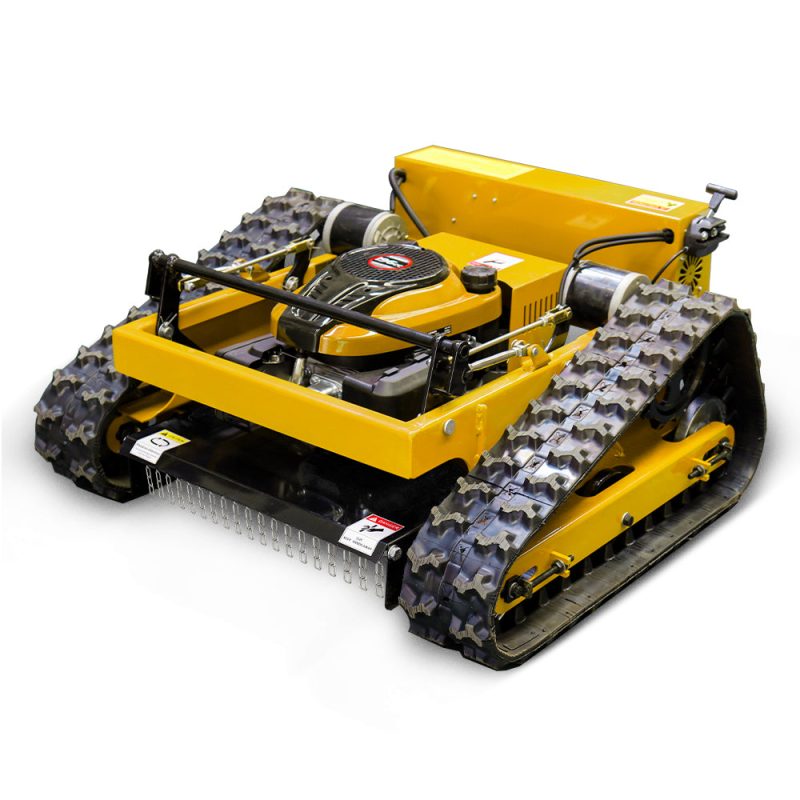
- Tracked RC mowers — Superior grip on wet slopes, soft soil, uneven ground, and rough terrain. The track system distributes weight evenly, preventing the sink-and-slide issue that makes wheeled mowers dangerous on soft hillsides. Example: MMS MS550J Tracked RC Mower.
MMS MS550J Tracked RC Mower — In Depth
At $1,199, the MMS MS550J Tracked RC Mower is the most terrain-capable machine in its price class. Here’s what makes it the right choice for specific property types:
- Track system advantage: The crawler track design distributes the mower’s weight across a wider surface area than any wheeled machine. On wet clay slopes — the kind that send riding mowers sliding — the MS550J maintains grip. This is the single most meaningful safety feature for hillside properties.
- 30–35° slope capacity: Handles most residential hillside grades. Steeper than 35° may still require professional equipment or specialized approach.
- Rough terrain capability: Unlike wheeled mowers that bog down in soft or uneven ground, tracked crawlers traverse rutted paths, dappled meadows, and soft soil without sinking.
- Engineered for wet conditions: The tracked platform prevents the side-to-side slippage that occurs on wet slopes with rubber-tire equipment.
- 22-inch cutting deck: Adequate for properties up to 3 acres; larger properties may require 2 sessions.
- 3.8HP engine: Sufficient power for thick grass, light brush, and tall weeds in typical lawn conditions.
View the MMS MS550J at The SUP Desk →
The MS550J is the right choice for: Properties with wet or soft slopes, uneven terrain, areas standard mowers can’t access, or any hillside property where maintaining grip is the primary safety concern. If your property has any of these conditions, the tracked platform is worth the slight speed disadvantage versus a wheeled unit.
AHM Gasoline RC Mower — In Depth
At $2,499, the AHM Gasoline RC Remote Control Lawn Mower is a wheeled unit optimized for slope performance (up to 45°) combined with higher ground speed on moderate terrain. Key specs:
- 5 HP gasoline engine: Higher power output for thicker grass, longer stems, and heavier cutting conditions.
- 545-yard remote range: One of the longest ranges available, letting you operate from a safe distance even on large properties.
- 45° slope capacity: Slightly steeper maximum angle than the MS550J — appropriate for properties with very steep but relatively smooth grades.
- Higher speed on flat land: Wheeled mowers move faster on level ground than tracked units, making the AHM better for large, relatively flat properties where slope performance is needed but terrain is otherwise manageable.
View the AHM Gasoline RC Mower at The SUP Desk →
The AHM is the right choice for: Properties with steep (up to 45°) but smooth slopes and the need for higher cutting speed across moderate acreage. If your hillside is steep but the ground is solid and even, the AHM’s speed advantage is meaningful.
RC Mower Comparison: MMS MS550J vs AHM
| Feature | MMS MS550J (Tracked) | AHM (Wheeled) |
|---|---|---|
| Price | $1,199 | $2,499 |
| Drive Type | Track / Crawler | Wheeled |
| Slope Capacity | 30–35° | 45° |
| Terrain Suitability | Wet, soft, rough, uneven | Steep but smooth grades |
| Speed on Flat Ground | Moderate | Higher |
| Engine | 3.8 HP | 5 HP Gasoline |
| Remote Range | 200–400 yards | 545 yards |
| Best For | Hillside, wet, uneven terrain | Steep slopes, moderate terrain |
RC Mower Pros and Cons
| Pros | Cons |
|---|---|
| Operator stays off the slope — full safety advantage over riding mowers | $1,199–$2,499 upfront investment |
| Significantly lower long-term cost than lawn service ($7,000–$12,000+ over 5 years) | Requires supervision during operation |
| Handles terrain standard mowers cannot access | Slower than a riding mower on flat, open land |
| Available now — no subscription, no installation fees | Gasoline models require fuel and basic engine maintenance |
| 5-year total cost: ~$3,000 (RC) vs ~$10,000+ (lawn service) |
5-year cost comparison: RC mower (~$3,000 total with fuel and basic maintenance) vs. professional lawn service ($7,000–$12,000+ over the same period). The math favors RC mowers for any property larger than half an acre where slope or rough terrain is a factor.
Shop MMS MS550J — $1,199 → Shop AHM Gasoline RC — $2,499 →
Best for: Homeowners with slopes, large properties, or anyone who wants to stop being physically present during mowing.
2. Robotic Autonomous Lawn Mower
Fully autonomous mowers navigate within a virtual boundary and cut on a schedule — daily or every few days — returning to their dock to recharge between sessions. No operator input required once the perimeter is set and the schedule is configured.
The technology has improved substantially. 2026 models from brands like Husqvarna, EcoVision, and Mammotion offer GPS-assisted navigation, multi-zone programming, and obstacle avoidance. But the fundamental limitation for large-yard homeowners with slopes remains: performance degrades significantly on grades over 20–30°.
Key Specifications for 2026 Robotic Mowers
- Maximum slope capacity: Most models handle 20–30°. Premium models (Husqvarna X-line) reach 35–45° but at a significantly higher price point ($4,000–$7,000+).
- Cutting area coverage: 0.5–5 acres depending on model — though real-world performance drops as complexity increases.
- Setup requirements: Perimeter wire installation (or virtual boundary via GPS on newer models), charging dock placement, WiFi connectivity for app control.
- Operating cost: Primarily electricity — approximately $30–$80/year depending on usage and local electricity rates.
See RC Mower Options at The SUP Desk →
Pros and Cons
| Pros | Cons |
|---|---|
| Truly hands-off after initial setup | $3,000–$7,000+ for large acreage capable units |
| Consistent, frequent cutting — lawn stays at uniform length | Struggles with slopes over 25–30° on most models |
| Quiet electric operation — runs at night without noise complaints | Perimeter wire installation required (or GPS boundary setup on newer models) |
| Low operating cost — electricity only | Theft risk — units left in yards are visible targets |
| GPS and app-based control with real-time status | Complex properties with multiple zones require careful planning |
| No fuel, no oil changes, minimal maintenance | Does not handle tall grass or brush — requires a regular baseline to function |
Best for: Flat large yards (under 3 acres) where slope is not a concern and the homeowner wants true automation with no ongoing supervision. If you have slopes over 20°, an RC mower like the MMS MS550J is a better use of budget.
3. Professional Lawn Service
Zero effort for a price. For homeowners who genuinely have no time and view lawn maintenance as a pure cost-of-living expense, professional service is the simplest option. Biweekly mowing on a 1-acre property runs $1,400–$2,450 per year in most US markets.
Over a 5-year horizon: $7,000–$12,250+. Over 10 years: $14,000–$24,500. This is the most expensive option by a significant margin — and it doesn’t include landscaping, edging, or spring/fall cleanup, which typically add $300–$800 per event.
Pros and Cons
| Pros | Cons |
|---|---|
| Zero time or equipment burden for the homeowner | Highest long-term cost by far — $7,000–$12,000+ over 5 years |
| No maintenance, no fuel, no storage required | Scheduling dependency — you’re subject to their availability |
| Professional equipment handles most conditions | No control over cutting height, timing, or quality |
| Service typically includes edging and blowing | Most services don’t handle steep slopes — may require separate specialist |
Best for: Homeowners who genuinely have zero time and are comfortable with ongoing costs. If budget is not the constraint and time genuinely is the only consideration, professional service is viable. But for any homeowner who wants to optimize the cost-to-benefit ratio of their property maintenance, an RC mower pays for itself within 2–3 years versus this option.
4. Zero-Turn Riding Mower
The fastest option for large, flat acreage. Zero-turn mowers cut mowing time by 40–60% compared to standard lawn tractors on open lots — the tight turning radius lets you cover more ground without overlap. Professional landscapers use zero-turn units for this reason.
But you are operating the machine for the entire session. And rollover risk on slopes above 15–20° is a real, documented hazard. Standard consumer zero-turn mowers have a higher center of gravity than lawn tractors, making them more prone to tip on slopes. If your property has any significant slope, this is not the right choice.
Pros and Cons
| Pros | Cons |
|---|---|
| Fastest cutting speed for large flat properties | Active operation required for full session |
| 40–60% time savings versus standard tractors | Significant rollover risk on slopes above 15–20° |
| Clean cutting pattern — professional appearance | Higher upfront cost ($3,000–$8,000 for quality units) |
| Wide cutting decks available (48–60″) | Storage, fuel, and maintenance required |
Best for: Flat 3–10 acre properties where cutting speed matters above all and the terrain is genuinely flat. If you need the speed but have slopes, the RC mower (either MMS MS550J or AHM) is the safer choice despite being slower.
5. Ground Cover Conversion
Replace traditional turf grass with lower-maintenance ground covers that reduce mowing frequency by 60–80%. This is a multi-year investment rather than a season-to-season solution — but for the right property, it fundamentally changes the maintenance burden.
Viable Ground Cover Options
- Clover lawns: Fix nitrogen in the soil (reducing fertilizer need), stay green through drought, require mowing 3–4x per season versus 20+ for traditional grass. Establishes in one growing season. Cost: $200–$500 for seed + soil prep on a half-acre.
- Native grass meadows: Once established (2–3 years), require 1–2 cuts per season. Ideal for rural properties where a formal lawn isn’t required. Cost varies significantly based on site prep and seed selection.
- Wildflower/meadow mixes: Maintain biodiversity, support pollinators, and require minimal ongoing maintenance after establishment. Best for properties where a natural aesthetic is acceptable.
- Drought-tolerant perennials: For arid regions, replacing grass with established drought-tolerant plants reduces water usage to near zero and eliminates mowing entirely.
Pros and Cons
| Pros | Cons |
|---|---|
| 60–80% reduction in mowing frequency after establishment | 2–3 year establishment period with continued maintenance |
| Dramatically lower water and fertilizer requirements (clover) | HOA restrictions may require formal turf in some neighborhoods |
| Environmentally beneficial — supports pollinators, reduces emissions | Property aesthetic changes significantly — not reversible quickly |
| Eliminates ongoing fuel and equipment costs after transition | Initial soil preparation and seed/plant cost can be significant |
| Some ground covers stay green through drought conditions that kill grass | May require re-seeding or repair if establishment fails |
Best for: Rural properties where lawn aesthetics are flexible, areas with water restrictions, homeowners willing to invest in a multi-year transition. If you’re on 2+ acres in a non-urban setting and have flexibility on appearance, this is the lowest long-term maintenance option available.
Side Note: Forestry Mulcher for Large Rural Properties
If your property is over 5 acres and includes brush, overgrown fields, or areas that have gone beyond what a standard mower can handle, a forestry mulcher is worth considering. These units attach to compact tractors and process brush up to 3–4 inches in diameter, clearing overgrown areas into tractable ground cover.
Rental costs run $300–$600/day. For a property with 5–20 acres of overgrown field, a weekend rental clears what would take a standard mower the entire growing season to barely maintain. After clearing, standard equipment or ground cover conversion can manage the regrowth annually.
Full Comparison Table
| Method | 5-Year Cost | Your Time | Slope Capable | Large Yard | Best Terrain |
|---|---|---|---|---|---|
| MMS MS550J RC Mower (Tracked) | ~$1,800 | Supervision only | Yes (30–35°) | Yes (up to 3 acres) | Wet, soft, rough, uneven slopes |
| AHM RC Mower (Wheeled) | ~$3,000 | Supervision only | Yes (45°) | Yes | Steep but smooth slopes |
| Robotic Mower | $4,000–$9,000 | None (after setup) | Limited (20–30° typical) | Yes (cost rises sharply) | Flat, open properties under 3 acres |
| Professional Lawn Service | $7,000–$12,000+ | None | Yes (if provider handles) | Yes | Any — as long as provider serves the area |
| Zero-Turn Riding Mower | ~$5,000 | Full operation | Limited (15–20° max) | Yes (fastest) | Flat, open large acreage |
| Ground Cover Conversion | Variable (low long-term) | Minimal (after year 2) | Yes | Yes | Rural properties, water-restricted areas |
Bottom Line
For most large-yard homeowners in 2026, a remote control lawn mower hits the sweet spot. Not paying lawn service prices year after year. Not operating a machine for hours. Not risking a rollover on a slope.
The MMS MS550J Tracked RC Mower at $1,199 is the best value for properties with wet, soft, or uneven slopes — the track platform is the meaningful differentiator. The AHM Gasoline RC Mower at $2,499 is the better choice for very steep (up to 45°) but smooth terrain where speed on flat ground is also valued.
Shop MMS MS550J — $1,199 → Shop AHM RC Mower — $2,499 →
Both are available at The SUP Desk with full product support. Pick based on your terrain type — the track vs. wheel decision is the most important one on this list.
Frequently Asked Questions
Are remote control mowers safe on steep slopes?
Yes — significantly safer than riding mowers. With an RC mower, you operate from a standing position at a safe distance, not from a seated position on a machine that could roll. The MMS MS550J’s tracked platform provides grip on wet slopes where rubber-tire equipment loses traction. For slopes over 30°, the tracked platform is meaningfully safer than any wheeled option.
How much does professional lawn service cost per year?
Biweekly mowing on a 1-acre property typically runs $1,400–$2,450 per year depending on your region. Over 5 years that’s $7,000–$12,000+. Over 10 years: $14,000–$24,500. This doesn’t include spring/fall cleanup, landscaping, or edging — those typically add $300–$800 per event. An RC mower like the MMS MS550J ($1,199) pays for itself within the first 12–18 months versus ongoing service costs.
Can robotic mowers handle sloped yards?
Most consumer-grade robotic mowers handle slopes up to 20–30° depending on the model. Premium models (Husqvarna X-line) handle up to 35–45° but cost $4,000–$7,000+. If your property has significant slope, a robotic mower’s effectiveness drops substantially and cost escalates quickly. An RC mower is a better value for slope-heavy properties.
Is ground cover conversion allowed in residential neighborhoods?
It depends on your HOA and local ordinances. Many HOAs require maintained turf grass as the primary ground cover. Before committing to a ground cover conversion, check your HOA covenants and local vegetation ordinances. In rural or non-HOA areas, ground cover conversion is generally unrestricted and is often encouraged for water conservation.
What maintenance does an RC mower require?
Gasoline RC mowers (like the AHM) require standard engine maintenance: oil changes every 50 hours, air filter cleaning/replacement, blade sharpening, and fuel system maintenance. The MMS MS550J’s smaller engine has similar requirements at a smaller scale. Neither requires the kind of maintenance complexity of a riding mower — and neither requires you to operate the machine, so mechanical issues don’t translate to physical strain.
How long does it take to mow 2 acres with an RC mower?
With the MMS MS550J’s 22-inch cutting deck on flat terrain, 2 acres takes approximately 2–3 hours of supervision time. The machine operates continuously while you monitor and adjust direction. For steeper or more complex terrain, budget 3–4 hours. This is active supervision time — you’re not pushing or riding, but you’re directing the machine. Compare this to the full physical exertion of riding a zero-turn for the same area.
Which RC mower should I buy — tracked or wheeled?
If your property has any wet soil, uneven terrain, soft ground, or slopes over 25°, go with the MMS MS550J tracked mower. The track platform is the single most meaningful safety and performance feature for hillside properties. If your slopes are steep (up to 45°) but the ground is solid and relatively even, the AHM wheeled mower‘s higher speed and 45° slope capacity make it the better flat-land performer.
View MMS MS550J at The SUP Desk →
Related reading: Lawn Mowing Time Calculator — How Much Time Are You Wasting? | Gasoline RC Remote Control Lawn Mower Review | RC Mower Size Calculator